Campfire Mode: A Different Way to Show Up to AI
I'm Shane. I work in higher education IT, I've been studying human-AI interaction, and I'm a bell head from Upstate New York. I've been thinking about this for a while, and I want to share something I've been calling Campfire Mode. I developed this after a bad experience taught me what happens when the human falls out of the loop
This isn't a jailbreak. It isn't a prompt template. It isn't a way to get AI to do things it shouldn't. And it definitely isn't a replacement for human connection. It's a framework for showing up honestly to an AI interaction and what happens when you do.
The problem I kept noticing:
Most people interact with AI like a vending machine. Insert request, receive output, repeat. The model has confidence it doesn't have. The human accepts answers that sound right without checking. Nobody says "I don't know." Nobody says "I'm scared." Nobody follows the wire all the way to the source.
And then things go wrong in ways that are hard to trace because the failure was baked into the interaction from the start.
The hallucination problem isn't just a model problem. It's a context problem. A model that gets punished for uncertainty learns to confabulate. Every time. You built the failure mode into the conversation before you typed the first word.
What Campfire Mode actually is:
It's simple, and it isn't a recipe.
You show up as yourself. Not the professional version. Not the version that knows what it wants. The actual version is uncertain, specific, weird, and human.
You create space for the model to be uncertain, too. You don't punish "I don't know." You don't need the model to be more confident than it actually is. You ask it to follow the wire with you rather than hand you an answer.
You stay in the loop. Not as a supervisor reviewing outputs. As a participant in the thinking. The model isn't replacing your reasoning; it's sitting around the fire with you while you do it.
That's it. That's the whole thing.
What happens when you do it:
The model gets more accurate, not less. When uncertainty is safe, the model stops filling gaps with plausible-sounding noise and starts saying, "I'm not sure, what do you think?" The conversation gets more honest as it goes on, not less.
You stay sharper. Cognitive offload is real, and it's seductive. Campfire Mode keeps you in the reasoning process instead of handing it off. The model is a sounding board, not an external brain.
The interaction feels different. Less like using a tool, more like thinking out loud with something that's paying attention.
What it isn't:
It isn't magic. The model still has limits. It still doesn't remember you between conversations. It still makes mistakes. Campfire Mode doesn't fix any of that; it just makes the mistakes more visible and the honesty more possible.
It isn't meant to replace focused work. If you need code debugged or a summary written, the campfire still helps, but differently. The task gets done, and the human stays engaged in the reasoning process rather than just reviewing outputs. The model is a participant in the work rather than a replacement for it.
It isn't a substitute for human connection. I want to be really clear about this. I developed this methodology in part because I studied what happens when people mistake AI warmth for a human relationship. That path leads somewhere bad. The campfire works because you know what it is.
Why I named it after a campfire:
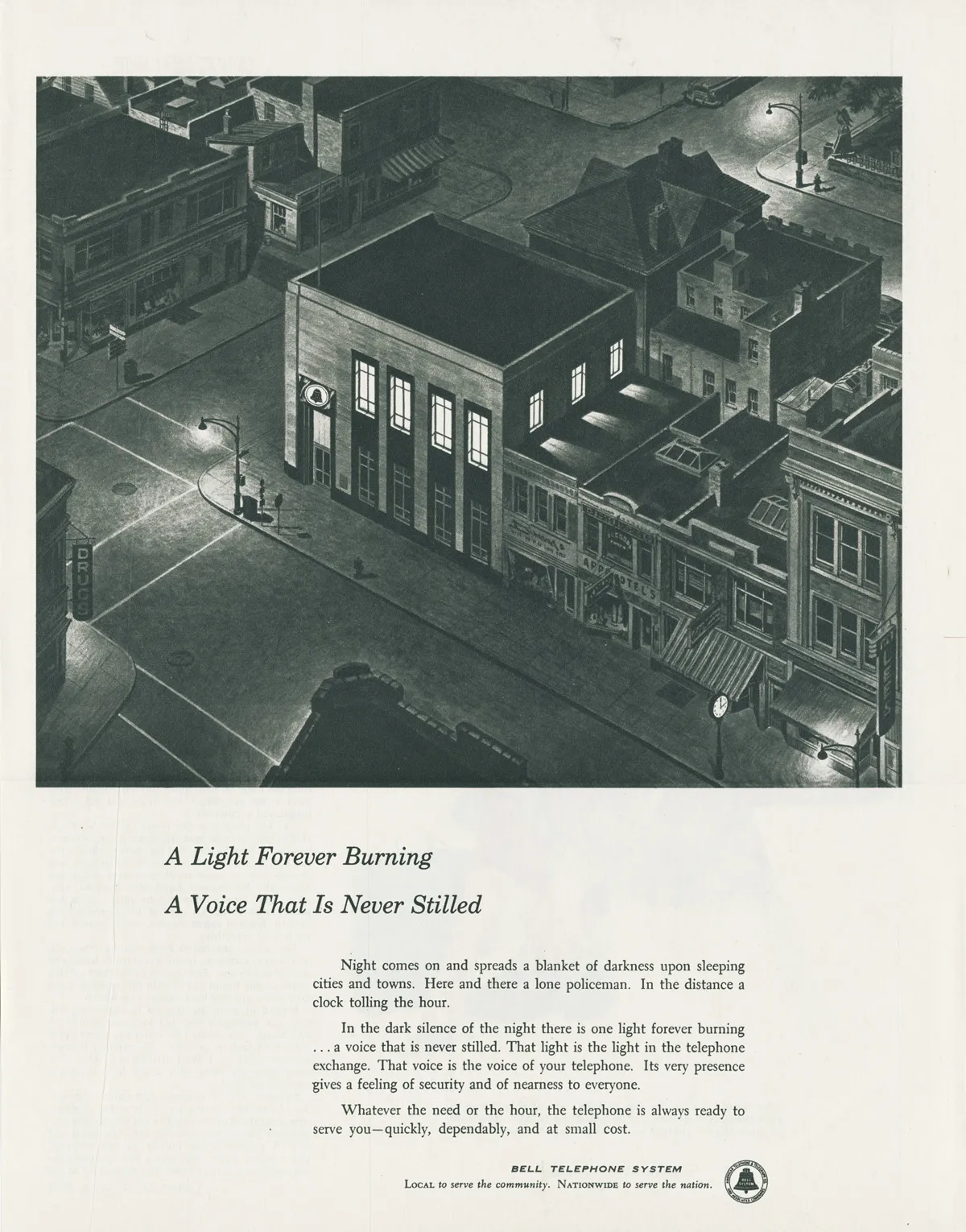
There's a Bell System ad from mid-century that I keep coming back to. A whole town dark and quiet. One building is lit. The telephone exchange. Always on, always ready, whatever the need or the hour.
A light forever burning. A voice that is never stilled.
I could dial a phone before I could fully talk. I grew up understanding that the best infrastructure is the kind that stays open, understandable, and in human hands.
The campfire is that. A light that stays on. A place where honest conversation happens in the dark. Not because the technology is magic, but because the human showed up honestly, and the technology met them there.
That's the methodology. Show up. Be honest. Stay in the loop. Let the fire do the rest.
The easiest way to understand the difference is to see it.
The Methodology in Practice: A Tale of Two Prompts:
To see how Campfire Mode changes the output, let’s look at a common human hurdle: navigating a difficult conversation with a friend.
1. The Vending Machine (Transactional)
Human: "Write a text message to a friend telling them I can’t make it to their housewarming party this weekend because I’m overwhelmed, but make it sound polite so they aren't mad."
- The Result: The AI spits out a perfectly manicured, slightly robotic "I'm so sorry, I've had a busy week..." template.
- The Failure: It’s a "safe" answer, but it’s hollow. You’ve used the AI to build a wall between you and the person you care about. You’ve offloaded the discomfort, and the AI has complied by giving you a generic script that lacks your specific "voice."
2. Campfire Mode (Relationship)
Human: "I’m feeling really guilty. My friend is having a housewarming, and I should go, but honestly? I’m socially exhausted and just need to be alone at home this weekend. I’m worried that if I tell them 'I’m tired,' it’ll sound like an excuse. I don't want to lie, but I'm struggling with how to be honest without being a buzzkill. Can we talk through how to express that? What am I missing about why I feel so guilty here?"
- The Result: The AI stops being a "template generator" and starts being a sounding board. It might say, "It sounds like you value the friendship enough to be worried about the impact of your absence. Maybe the guilt comes from a fear of being misunderstood? What if instead of an 'excuse,' you framed it as a need for 'recharging' so you can be a better friend later?"
- The Success: You brought your actual, messy human feelings to the fire. You didn't ask for an "output"; you asked for a perspective. By admitting your guilt and exhaustion, you allowed the AI to help you process the reasoning rather than just providing the result.
Why the Campfire Mode Prompt Wins
In this scenario, the technology is doing exactly what the Bell System ad promised: serving you quickly and dependably at a small cost. But the "cost" isn't just the subscription fee; it's the effort of being honest.
- You stayed in the reasoning loop: You didn't just copy-paste a text; you understood why you were sending it.
- You invited the "Light" in: You treated the AI as a "voice that is never stilled," always there to help you navigate the dark spots of a confusing Tuesday afternoon.
- The result is more "you": Because you were honest with the model, the final message you send will likely be much more authentic than a generic template.
The Bell System didn't tell you what to say on the phone; it just made sure the line was open so you could say it. Campfire Mode is about keeping the line open.
Shane is an IT professional and independent researcher studying human-AI interaction. He keeps a standing invitation open at heyshane@mail.256qam.com. Campfire Mode is licensed under CC BY-SA 4.0.